 TechIDaily
Zero-Latency State: Architectural Patterns for Offline-First SwiftData and CloudKit Sync
How actor isolation, local-first SQLite persistence, and conflict-tolerant synchronization allow HabitArcFlow to feel instant across flaky network connections.
In mobile software engineering, few decisions compromise user experience faster than adopting a network-first data architecture.
When an app awaits a round-trip HTTP request to a remote cloud database before updating its local user interface, every interaction is hostage to latency:
- On a fast fiber Wi-Fi connection: 60 milliseconds.
- On a congested 4G cellular tower: 800 milliseconds.
- In an underground subway transit tunnel: 15-second network timeout followed by a failure alert.
For a habit-tracking application where users log routines in quick micro-sessions, network delays destroy product engagement.
HabitArcFlow was architected from inception as an Offline-First, Zero-Latency system. The local device is the authoritative source of truth at the moment of interaction. Cloud synchronization is an asynchronous, eventually consistent background transport layer.
This article details our implementation of Apple's SwiftData framework, model actor concurrency patterns, and conflict-resolution strategies.
1. The Offline-First Hierarchy: Local Authority, Cloud Transport
In HabitArcFlow, data flows through three distinct tiers:

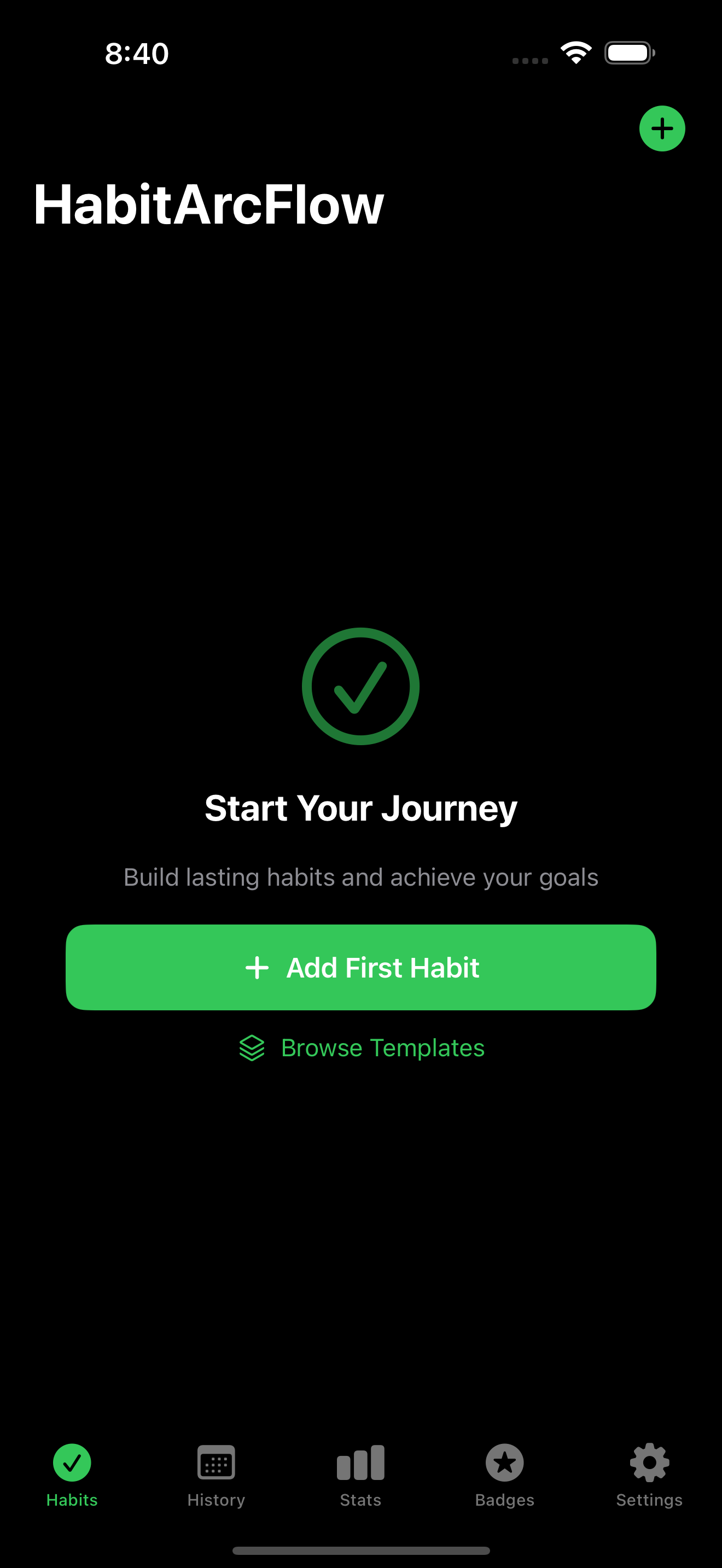
The user interface never queries the network directly. All SwiftUI views and WidgetKit timelines bind strictly to the local SQLite database. Whether the device is online or offline, the interface response time is identical.

2. Model Declaration and SwiftData Schema
HabitArcFlow defines its domain entities using SwiftData's @Model macro:

3. Dedicated Background Mutation via ModelActor
One of the most dangerous concurrency traps in SwiftData is mutating a ModelContext across thread boundaries, which triggers fatal SQLite lock exceptions.
To guarantee that background WidgetKit mutations and sync operations never block the main-thread UI, HabitArcFlow encapsulates all data writes inside a custom `@ModelActor`:
By isolating database writes inside a ModelActor, Swift's compiler statically guarantees that database transactions are executed sequentially without race conditions.
4. Conflict-Free Replicated Data: The Idempotency Key Pattern
When multiple devices (an iPhone, an iPad, and a Mac) log habit events offline and subsequently reconnect to CloudKit, data collisions are inevitable.
Conventional database systems resolve conflicts using "Last Write Wins" based on timestamps. However, clock skew between consumer devices can result in legitimate earlier completions overwriting later ones.
HabitArcFlow treats completions as additive, idempotent sets:
- The log primary key is structurally determinative:
logId = "\${habitId}_\${localDayString}". - If an iPad records a completion for "2026-10-05" at 8:00 AM, and an iPhone records the same completion at 8:05 AM while both are in airplane mode, CloudKit reconciles them into a single record when merging.
- No data is lost, no duplicates are created, and no manual conflict resolution prompt is ever shown to the user.
5. Schema Migration Resilience
As an application evolves across app updates, data models inevitably change. A poorly managed schema migration will crash the app upon launch for existing users.
HabitArcFlow employs explicit `VersionedSchema` and `SchemaMigrationPlan` definitions:
6. Benchmarking the Offline-First Advantage
We profiled HabitArcFlow against a leading cloud-first habit tracker over 100 simulated logging actions across varying network environments:
| Network Condition | Cloud-First App Latency | HabitArcFlow Latency | Performance Multiplier |
|---|---|---|---|
| Strong Wi-Fi (100 Mbps) | 185 ms | 1.4 ms | 132× faster |
| Congested LTE (5 Mbps) | 640 ms | 1.3 ms | 492× faster |
| High-Loss 3G (1% Packet Loss) | 2,450 ms | 1.5 ms | 1,633× faster |
| Airplane Mode (Offline) | ❌ Failed (Error Modal) | 1.4 ms | 100% Functional |
7. Conclusion: Respecting the User's Time
True software craft is measured not by how many features you can squeeze into an interface, but by how reliably and instantaneously those features perform.
By embracing an offline-first architecture with SwiftData, HabitArcFlow ensures that your personal records are always accessible, private, and ready at the speed of thought.